|
| The Carrot Bus Shelter, Weston super Mare |
Having put on half a stone in weight over the winter the time has come for a few early summer walks along the Somerset coast. Perfect timing - just before the schools break up and the onslaught of holiday makers begins. The weather has also picked up so there is nothing to stop me. All I have to do is set my mind to getting out and about rather than sitting and researching at my computer.
Yesterday's outing started at The Carrot Bus Shelter in Weston super Mare where I caught the No. 20 bus to Brean Village Hall. The half hour bus route meanders its way through the twisty narrow lanes of Lympsham passing delightful old farm houses on the way. What a relaxing way to start the day.


A couple of months ago I was fortunate enough to acquire a couple of old photograph albums on eBay. All that was known about them was that they captured scenes of farm life somewhere in Somerset towards the end of the First World War. After much research I narrowed the locations down to Lympsham and Brent Knoll. How wonderful to now be travelling along the same lanes and be looking out over the same fields as shown in those old photographs.

Alighting from the bus as Brean Village Hall I set off along Warren Road in search of a footpath which will take me up and over the sand dunes onto Berrow Flats. I find a track at the back of a car park and make my way up. The soft sand makes the going very difficult and my right ankle (still recovering from injury) complains bitterly at being strained with every step.

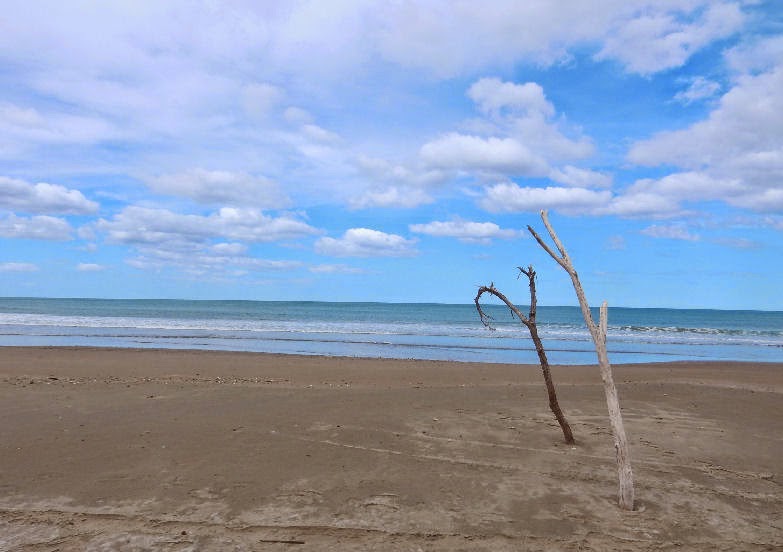
But it is well worth the effort. When I reach the top and slide down the dunes on the other side I am greeted with the wondrous sight of an almost deserted beach. On the right a couple of miles up to Brean Down and The National Trust Cafe. On the left 6 miles up to Burnham.

The only people I can see are a couple of elderly ladies walking their dogs and a friendly beach warden engaged in picking up other people's rubbish.

Being a loner this deserted beach looks like heaven on earth to me and I set off at a brisk pace towards Brean Down. My ankle thanks me for making for the wet sand which provides a modicum of support whilst cushioning the impact of footfall. Pounding for miles along concrete pavements does little to improve an injury. As I walk along the clouds began to melt away leaving the sun to sparkle on the receding sea.

Peaking out from behind the sand dunes I can see the tops of caravans and holiday chalets. What a wonderful location - bet it costs the earth to own one of those! 40 minutes later I reach the end of the beach and treat myself to a pot of tea from the cafe.

Sitting on the beach side deck I relax whilst watching a young man collect seaweed from the beach. At first I think it might be winkles that he is after but the photos show that he has seaweed in his hand. These days this natural product is much in demand by chefs. I wonder whether it will be sent to one of the prestigious London restaurants - or stay here in Somerset.

The elderly lady at the next table strikes up a conversation with me. She lives in Wincanton with her husband and they have been on a short break with their daughter. Unfortunately the past few days have been far too windy for them to enjoy the coastal views so they are making the most of this morning before travelling back home. I ask whether she knows Horsington where my father's family originate - of course she does. In fact one of her daughters had her reception in The Half Moon Inn which is almost opposite Lower Lodge where my Gran spent so many years of her life.
Rested and watered it is now time to set off for the very steep climb up the side of Brean Down. But the sun is shining brilliantly and I realise that, stupidly, I have left my sunhat at home. A quick visit to the National Trust Shop sorts me out with suitable headgear.

That leaves just one more mission before setting off on the climb - a trip to the loo. The cafe complex, of course, comes provided with a purpose built toilet block. Thank goodness. It is also FREE to use!

No putting it off any longer - those 150+ steps just have to be tackled.


Thankfully resting places are provided at several points on the way up so it does not have to be negotiated in one go. Perfect places to catch my breath and take some photos of the view down to the beach.

Here is the sight as I approach the top of the world. I hope the world IS round otherwise I could topple off when I reach the last step.

From a previous walk two years ago I know that the most picturesque route to The Fort is along the grassy footpath which climbs and falls over the ridges of various hills.

With a dodgy ankle I decide that I had better be sensible and make for the old military cinder track instead.
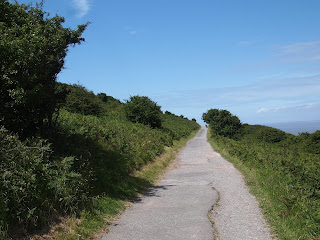
Glorious views back over the bay towards Weston certainly make the climb well worth the effort.

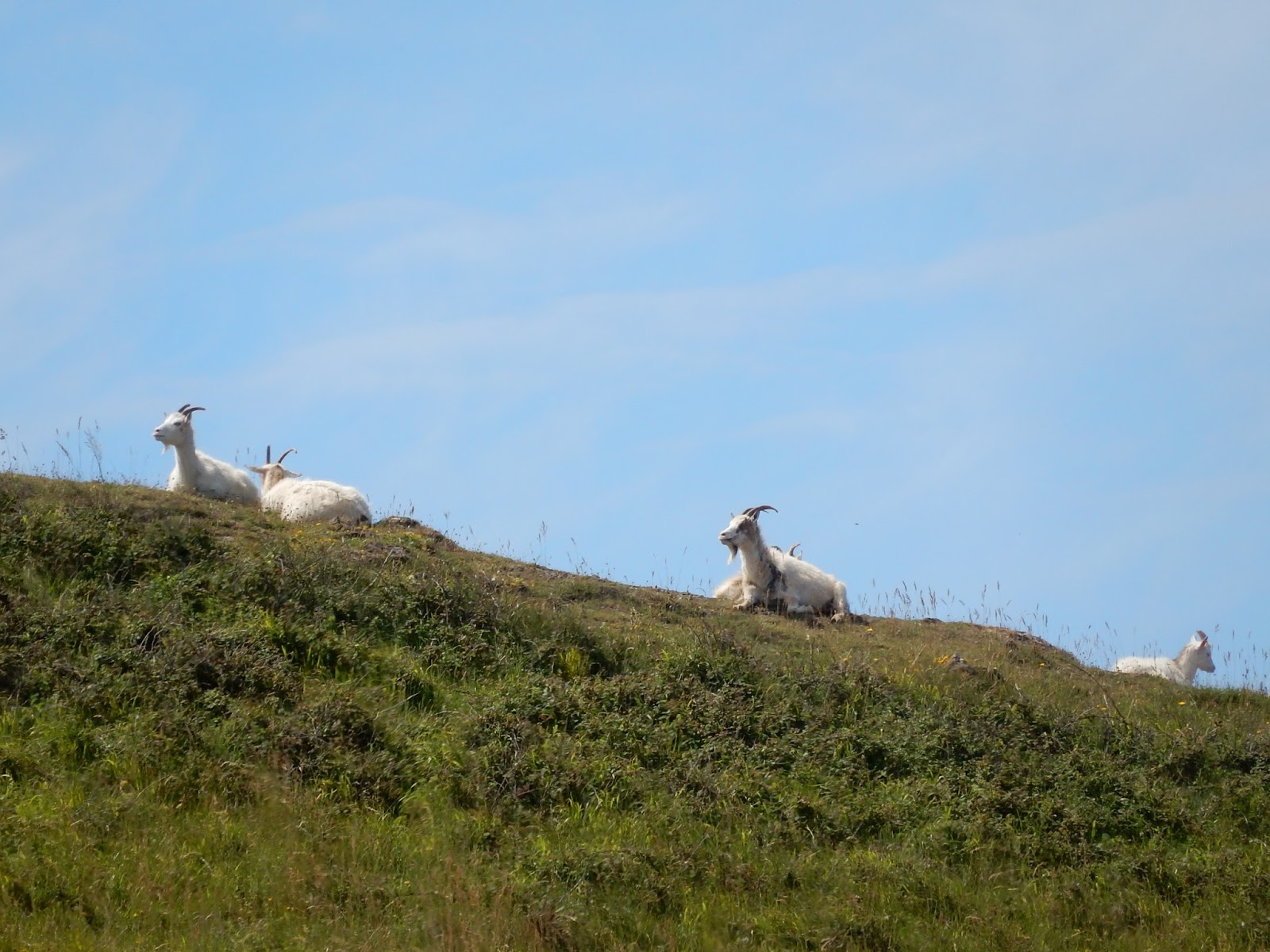
Wow, I really do feel as if I am on top of a mountain. Look - up on the ridge are a herd of goats enjoying a siesta.

At the end of The Down lies the old military fort.

The remains that we see here are of buildings built in the 1860s. It was one of a chain of fortifications known as Palmerston's Forts designed to protect us from the French - but its history actually dates way back to the Iron Age. On top of the furthest point can be seen the old Searchlight Tower.

Sitting atop one of the outer walls of The Fort proves the perfect place for my picnic lunch - a homemade eggy sarnie washed down with a bottle of water. Then its time to set off back along the cinder track - taking the route all the way down to the bottom as I know my ankle will not cope with descending those steep steps. On the final stage of the track I pass this very pretty gate with very ugly padlock. I wonder what those steps lead up to?

The cafe beckons once again and I stop for another pot of tea before heading back up the beach to Brean Village Hall. The tide has taken the sea way way out and suddenly I notice something very strange. There on the beach is a HUGE lump of jelly. I try to work out whether it is some sort of transparent Frisby but come to the conclusion that it must be a dead jelly fish. Cripes, how pleased am I that I am not a swimmer!

Finding the footpath exit off the beach proves far more difficult than I had imagined as one sand dune looks just like the next. In the end I take a narrow path that proves to be a few metres along from that where I had entered. I arrive at the bus stop in good time for the next bus and am delighted to find some Public Conveniences in a little building behind the bus shelter. Perhaps not so well appointed as those in the National Trust complex but still FREE and when you have to go you have to go.

When I return home and look at my FitBit pedometer it tells me that I have walked over 9 miles during the course of the day. Surely that will have taken a couple of pounds off my weight!

Alighting from the bus as Brean Village Hall I set off along Warren Road in search of a footpath which will take me up and over the sand dunes onto Berrow Flats. I find a track at the back of a car park and make my way up. The soft sand makes the going very difficult and my right ankle (still recovering from injury) complains bitterly at being strained with every step.

But it is well worth the effort. When I reach the top and slide down the dunes on the other side I am greeted with the wondrous sight of an almost deserted beach. On the right a couple of miles up to Brean Down and The National Trust Cafe. On the left 6 miles up to Burnham.


Being a loner this deserted beach looks like heaven on earth to me and I set off at a brisk pace towards Brean Down. My ankle thanks me for making for the wet sand which provides a modicum of support whilst cushioning the impact of footfall. Pounding for miles along concrete pavements does little to improve an injury. As I walk along the clouds began to melt away leaving the sun to sparkle on the receding sea.

Peaking out from behind the sand dunes I can see the tops of caravans and holiday chalets. What a wonderful location - bet it costs the earth to own one of those! 40 minutes later I reach the end of the beach and treat myself to a pot of tea from the cafe.

Sitting on the beach side deck I relax whilst watching a young man collect seaweed from the beach. At first I think it might be winkles that he is after but the photos show that he has seaweed in his hand. These days this natural product is much in demand by chefs. I wonder whether it will be sent to one of the prestigious London restaurants - or stay here in Somerset.

 |
| Lower Lodge, Horsington - October 1969 |
Rested and watered it is now time to set off for the very steep climb up the side of Brean Down. But the sun is shining brilliantly and I realise that, stupidly, I have left my sunhat at home. A quick visit to the National Trust Shop sorts me out with suitable headgear.

That leaves just one more mission before setting off on the climb - a trip to the loo. The cafe complex, of course, comes provided with a purpose built toilet block. Thank goodness. It is also FREE to use!

No putting it off any longer - those 150+ steps just have to be tackled.


Thankfully resting places are provided at several points on the way up so it does not have to be negotiated in one go. Perfect places to catch my breath and take some photos of the view down to the beach.

Here is the sight as I approach the top of the world. I hope the world IS round otherwise I could topple off when I reach the last step.


With a dodgy ankle I decide that I had better be sensible and make for the old military cinder track instead.

Glorious views back over the bay towards Weston certainly make the climb well worth the effort.

Wow, I really do feel as if I am on top of a mountain. Look - up on the ridge are a herd of goats enjoying a siesta.
At the end of The Down lies the old military fort.


Sitting atop one of the outer walls of The Fort proves the perfect place for my picnic lunch - a homemade eggy sarnie washed down with a bottle of water. Then its time to set off back along the cinder track - taking the route all the way down to the bottom as I know my ankle will not cope with descending those steep steps. On the final stage of the track I pass this very pretty gate with very ugly padlock. I wonder what those steps lead up to?

The cafe beckons once again and I stop for another pot of tea before heading back up the beach to Brean Village Hall. The tide has taken the sea way way out and suddenly I notice something very strange. There on the beach is a HUGE lump of jelly. I try to work out whether it is some sort of transparent Frisby but come to the conclusion that it must be a dead jelly fish. Cripes, how pleased am I that I am not a swimmer!


When I return home and look at my FitBit pedometer it tells me that I have walked over 9 miles during the course of the day. Surely that will have taken a couple of pounds off my weight!