Showing posts with label Weston-super-Mare Cemetery. Show all posts

Saturday, 26 July 2014

Weston-super-Mare - Above the Cove


In Victorian times Weston was a booming seaside resort.  An area on “Flagstaff Hill” was landscaped and turned into beautiful gardens with a rest pavilion enjoying stunning views.   


The gardens were named Prince Consort Gardens in memory of Prince Albert.  In 2013, due to tireless efforts by a small group of volunteers, the gardens were designated a Town Green meaning the area is safe from development.


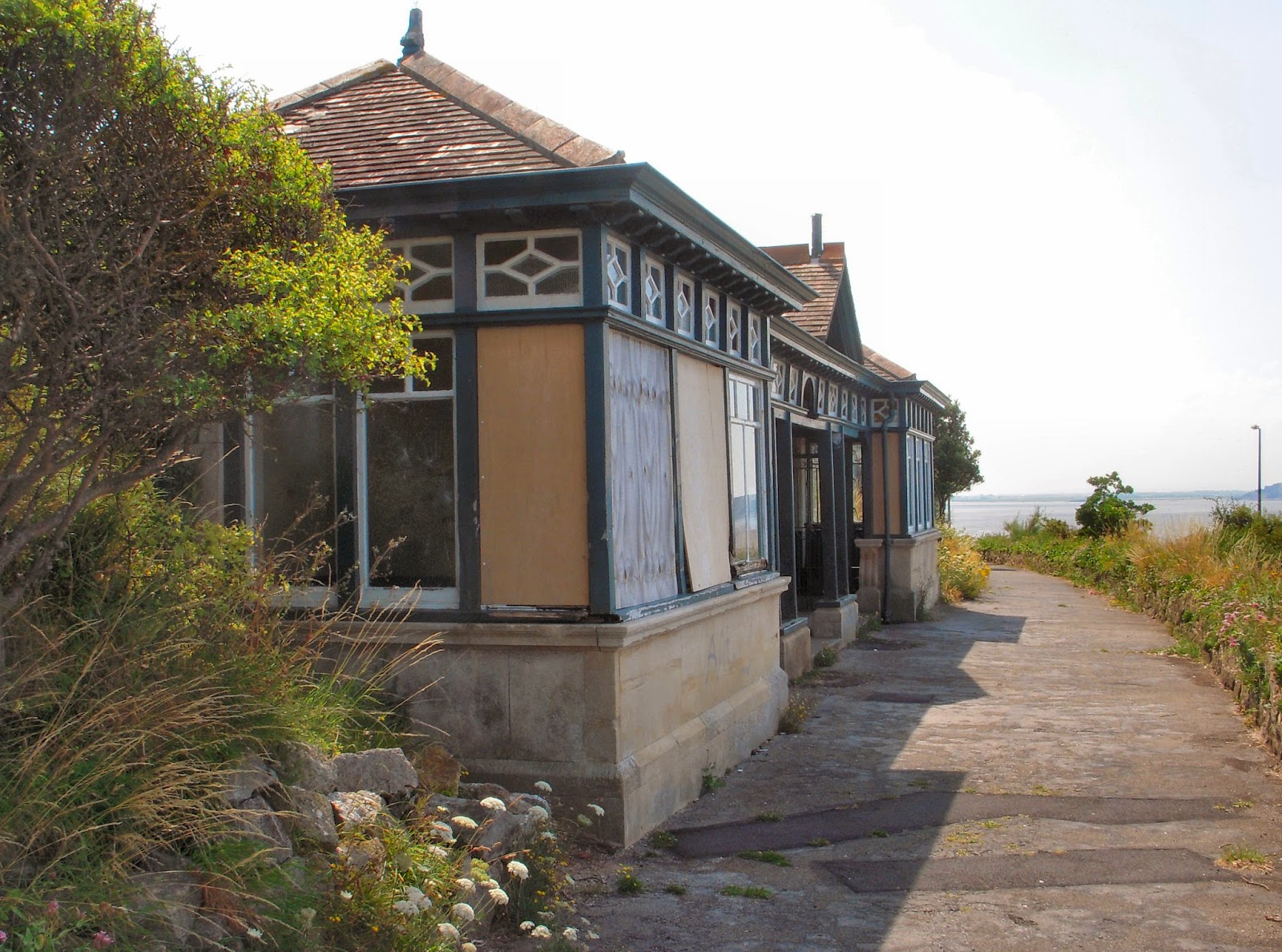
It is a delight to walk through the gardens in the early morning sunshine with hardly a soul to be seen.  Just a mile along The Prom. the beach is packed with holidaymakers but here all is peaceful.  The only sound is water trickling from a fountain in the lily pond.  But a sense of sadness overwhelms me - the Victorian Rest Pavilion is boarded up and looks decidedly neglected – a police warning notice adorns it’s once beautiful windows.

The map at the entrance to the gardens shows two small rectangles marked with the letters PC – these are just to one side of the lily pond.  What could these letters stand for?  Well, I reckon there is a fair chance that they once referred to a Public Convenience.  On looking around I see nothing that resembles a toilet block – but wait a minute, what is behind that very high hedge?  Further inspection reveals a padlocked gate but I can just see what appears to be a small building inside.  No doubt, these were the conveniences of days long ago but perhaps the area is now used by those who maintain the beautiful borders.


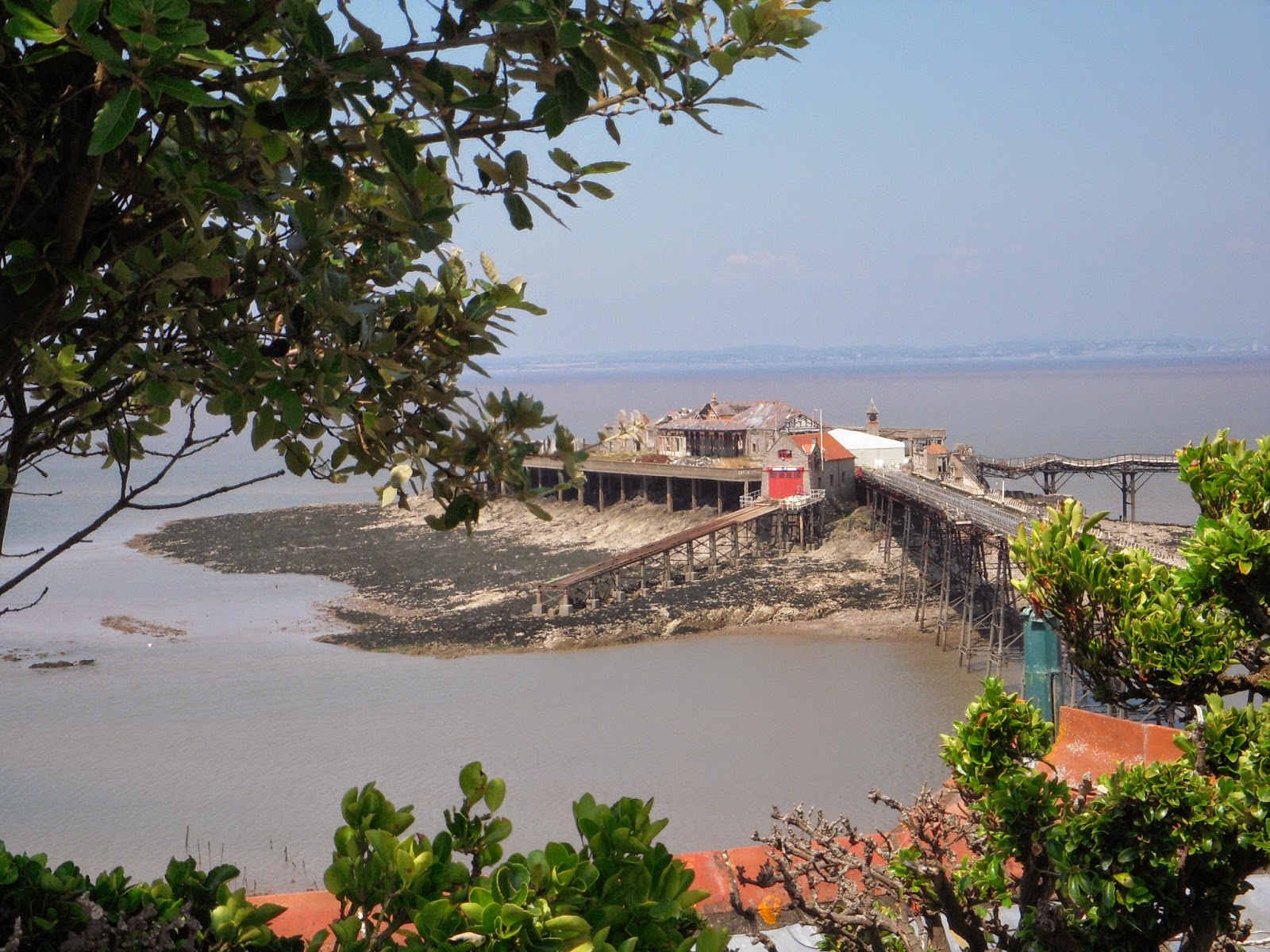
In 1867 Birnbeck Pier was built at the foot of the cliff joining a small island with the mainland.  In the 21st. century the view from the gardens is still as spectacular as it was in Victorian times but regrettably Birnbeck Pier is now a crumbling old lady.  


What fun she must have seen in the past – what a bustling place it must have been.  Now, even the RNLI have had to retreat as more and more planks fall to the sands below.  Even in it’s state of disrepair – or perhaps because of it’s dilapidated state - it is a location which draws me back over and over again.  How I wish I could get a little nearer to photograph it’s crumbling structure close up.

In January 1868 just a few months after the pier had been opened a couple of fishermen were walking across when they heard a loud snorting beneath their feet.  Thinking it was a tipsy man they made their way onto the beach to investigate.  To their surprise they found it was a large seal left “high & dry” on the pebbles.  Do we still get seals in Weston?  I can only provide a photo of one from New Zealand.

Riversdale, Wairarapa, New Zealand

At one time the Pier Master was a respected and well known member of the community.  Henry Alfred Cole had moved to Weston as a child in the 1870s.  He spent a career working for the Pier Company first as “Collector of Tolls” then as Pier Master.  He died in the Toll-house on 5 June 1937 and was buried in the Milton Road Cemetery a few days later.  


Walking along from Prince Consort Gardens - at the top of the steps which lead down to Cove CafĂ© (another of my favourite watering holes) - I come across another set of boarded up loos.  Apparently these were closed in 2009.


Never mind – because a little further around the Marine Lake path can be found The Cove Restaurant & Bar and that does have a toilet block to one side?  Well – it used to have a Ladies and Gents to one side!!  In 2014 the Ladies has been boarded up and what used to be the Gents is now a pay-to-enter Unisex facility.  There is a queue a mile long -

so I just have to wait until I get home 

Saturday, 19 July 2014

Milton Road Cemetery, Weston-super-Mare


Weston-super-Mare Cemetery

Having been let down the other day by finding no available toilets in Ashcombe Park a thought crossed my mind as to where the nearest available conveniences might be.  This morning – an overcast dismal Saturday – I decided to check out my theory and hey presto SUCCESS.

A little further along Milton Road from Ashcombe Park is the cemetery.  Just inside the front gates is an old toilet block.  It is concealed nicely by trees and if I had not consulted the chart of the cemetery I would not have realised these facilities were there.  Admittedly they cannot be compared to the refurbished loos in Grove Park but for anyone “caught short” they are better than nothing.  

Weston-super-Mare cemetery, Milton Road Toilets

My prime mission accomplished it was then time to set off around the cemetery taking photographs and seeing whether any headstones caught my eye in regard to making interesting stories.  The cemetery itself is certainly a photographer’s paradise with some areas being allowed to flourish in a natural state.  The delicate wild flowers and grasses gently blowing in the breeze were a delight to behold.   


The cemetery mouser idled by and we exchanged morning pleasantries.


A few minutes later I noticed two very large fledgling seagulls tottering down a path.  I stopped and chuckled at the sight but thought twice about trying to photograph them.  All of a sudden, above my head, I was aware of tremendous squawking and out of nowhere 20+ seagulls were circling and swooping.  Several decided to dive bomb and the sound of their powerful wings just inches above my head was terrifying.  My only defence was to wave arms in the air and dart to the nearest clump of trees for cover. 

However, the adventure was more than worth it because I did discover a number of headstones offering clues to interesting stories. As the delicate flowers have been mentioned above lets start with a story about the FLOWER family.

The FLOWER family of Weston-super-Mare

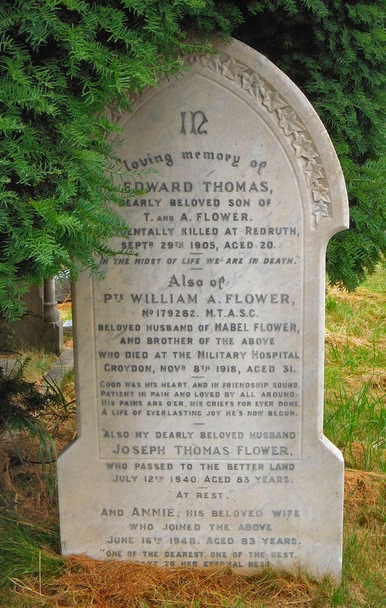
In the 1880s Joseph FLOWER worked for the Great Western Railway as a plate layer.  He and his wife, Annie, lived in Weston-super-Mare and their two eldest sons were Edward and William.  On 14 August 1902 Edward joined the GWR as an Engine Cleaner and two years later progressed to Shunter and Fireman.  With advancement came a move from home and by September 1905 Edward was living in lodgings in St. James Street, Penzance with a friend who was a GWR railway driver. 

On the morning of 29 September 1905 Edward was the Fireman on the 12.30 from Penzance.  As it approached Redruth Station little did he know that on the "down line" stood a cattle truck with its doors swinging open.  As the 12.30 passed by a door of the cattle truck hit the front of the train tearing the side and making an almighty row.  Instinctively Edward pushed his head out to see what all the commotion was about – he knew no more.  Death was instant.  To make matters even worse the driver of the train with the cattle truck was none other than Edward’s friend and room mate from Penzance.

13 years passed and England was in the midst of war.  Edward’s younger brother, William, had joined the Army Service Corps – Private DM2/179282.  Armistace Day was 11 November 1918 but William did not live to see it.  He died in the Military Hospital in Croydon just 3 days earlier. 

Edward and William lie together in the cemetery in Milton Road.